GuideCrops
Plant population: how many seeds to plant for your rainfall
The right number of plants per hectare depends on how much water your field can supply. Here is how to choose a target stand for maize and other crops, and turn it into seeds per metre and kilograms of seed.
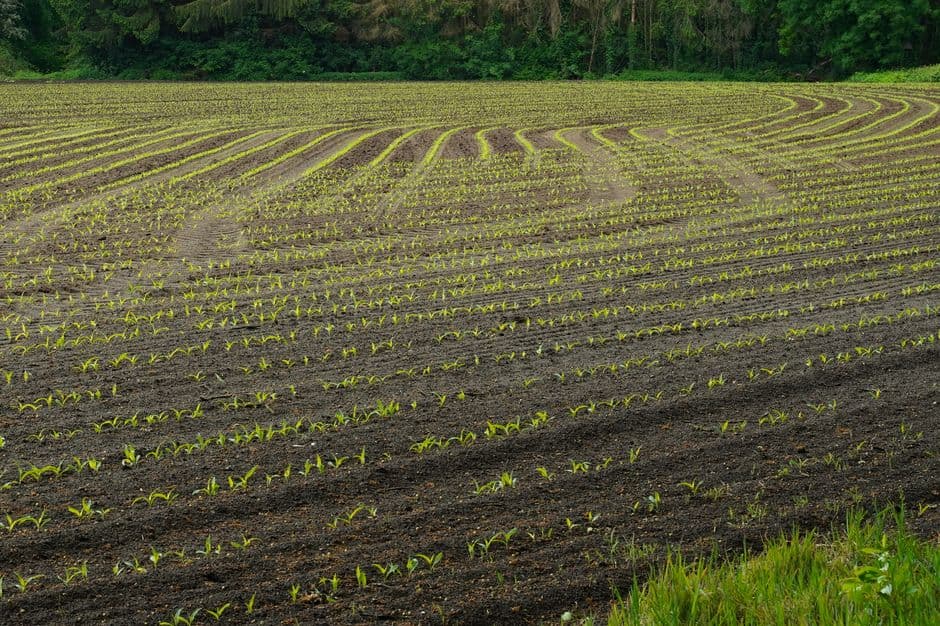
Plant population is one of the cheapest decisions you make all season and one of the hardest to fix later. Too few plants and you leave sunlight, nutrients and rain unused. Too many and the plants compete for water, so in a dry spell every plant suffers, cobs stay small and some plants produce nothing at all. The right number is not fixed: it depends mostly on how much water your soil and rainfall can supply during the season.
Start from water, not from habit
Many farmers plant the same number of seeds every year because that is what they have always done, or because the planter was set that way when it was bought. A better starting point is the expected seasonal rainfall plus the water already stored in the soil at planting. A deep, well-structured soil that is full of water at planting can carry more plants than a shallow sandy soil with the same rainfall.
In the summer rainfall regions of Southern Africa, dryland maize populations range widely. In drier western areas and on sandy soils, farmers commonly plant low populations, while on deep soils in higher rainfall areas the stand can be roughly double. East African smallholders using hand planting often work to a fixed spacing such as 75 cm between rows and 25 to 30 cm between planting holes, which lands at the higher-rainfall end of the range. Under full irrigation, populations are much higher again.
| Situation | Typical target (plants/ha) |
|---|---|
| Dry areas, roughly 350–500 mm seasonal rain, sandy or shallow soils | 15 000 – 25 000 |
| Moderate rainfall, roughly 500–700 mm, medium soils | 25 000 – 40 000 |
| Higher rainfall, above about 700 mm, deep soils | 40 000 – 55 000 |
| Full irrigation, high fertility | 60 000 – 90 000 |
Hybrids differ too. Some are bred to set one large cob and do well at low populations; others are designed to be planted densely. Seed companies publish recommended populations for each hybrid and rainfall band, so read the product guide before you settle on a number.
Other crops at a glance
- Sorghum and pearl millet tolerate dry conditions and tiller, so they compensate somewhat for a thin stand. Populations vary a lot by region; follow local recommendations.
- Soybeans are planted far more densely than maize, commonly a few hundred thousand plants per hectare, because each plant is small.
- Dry beans and cowpeas sit between maize and soybeans. Bush types are usually planted denser than spreading or climbing types.
- Groundnuts need a good, even stand because gaps are not filled in; poor stands are a common cause of low groundnut yields.
From plants to seeds
Your target is plants that survive to harvest, not seeds in the bag. Not every seed germinates, and not every seedling survives cutworms, crusting, birds or a hot, dry soil surface. So you plant more seeds than the plants you want.
- Find the germination percentage on the seed bag label, or do your own test: plant 100 seeds in moist sand or wet paper and count the seedlings after about a week.
- Estimate field survival. On a well-prepared seedbed in good conditions, 85 to 90 percent of germinating seeds may establish; in rough, crusting or dry conditions it can be much lower.
- Seeds needed per hectare = target plants ÷ (germination × field survival).
Example: you want 30 000 maize plants per hectare, germination is 90 percent and you expect 85 percent field survival. Seeds per hectare = 30 000 ÷ (0.90 × 0.85) = about 39 200 seeds.
Seeds per metre of row
A hectare is 10 000 square metres. Divide that by your row width to get the metres of row in a hectare. With rows 0.9 m apart there are about 11 100 m of row per hectare. Divide the seeds needed by that length: 39 200 ÷ 11 100 = about 3.5 seeds per metre, which is one seed roughly every 28 cm.
For hand planting with more than one seed per hole, work out the number of holes instead. At 75 cm rows and 30 cm between holes there are about 44 400 holes per hectare. Planting two seeds per hole and thinning to one plant gives a good even stand, but uses twice the seed.
Kilograms of seed to buy
Seed size varies between hybrids, varieties and even seed lots, so use the thousand-seed mass (the weight of 1 000 seeds, often on the label, or weigh 1 000 seeds yourself). Kilograms per hectare = seeds per hectare × thousand-seed mass in grams ÷ 1 000 000. For 39 200 maize seeds with a thousand-seed mass of 300 g, that is about 11.8 kg per hectare. Add a small margin for spillage and replanting.
Check the planter, then check the field
Planter plates and settings are the most common reason the stand is not what you planned. Before the season, run the planter over a hard surface or a short strip of loose soil and count the seeds dropped in 10 m of each row. Worn plates, the wrong plate for the seed size and driving too fast all cause skips and doubles.
About two to three weeks after emergence, count plants in several places across the field. Measure out the row length that equals one-thousandth of a hectare (11.1 m for 0.9 m rows, 13.3 m for 0.75 m rows) and count the plants; multiply by 1 000 for plants per hectare. Do this in at least five spots. If the stand is well below target, talk to your adviser before deciding whether to replant, because a late replant can cost more than it gains.
Key points
- Match population to the water your field can supply: lower on dry, sandy or shallow soils, higher on deep soils and under irrigation.
- Plant more seeds than the plants you want, using germination and expected field survival.
- Convert to seeds per metre of row and kilograms of seed so you can set the planter and buy the right amount.
- Calibrate the planter before the season and count the stand after emergence.
- Hybrid recommendations and local conditions matter; confirm your target with your seed supplier or extension officer.
This guide gives general information. Conditions differ from farm to farm, so confirm recommendations with your local extension officer, agronomist or veterinarian, and always follow the registered product label.